
Stop Smoking Weed Before Wisdom Teeth Removal?
Regular cannabis use can raise propofol needs during wisdom tooth surgery. Learn when to stop, what to disclose, and what to do after recent use.
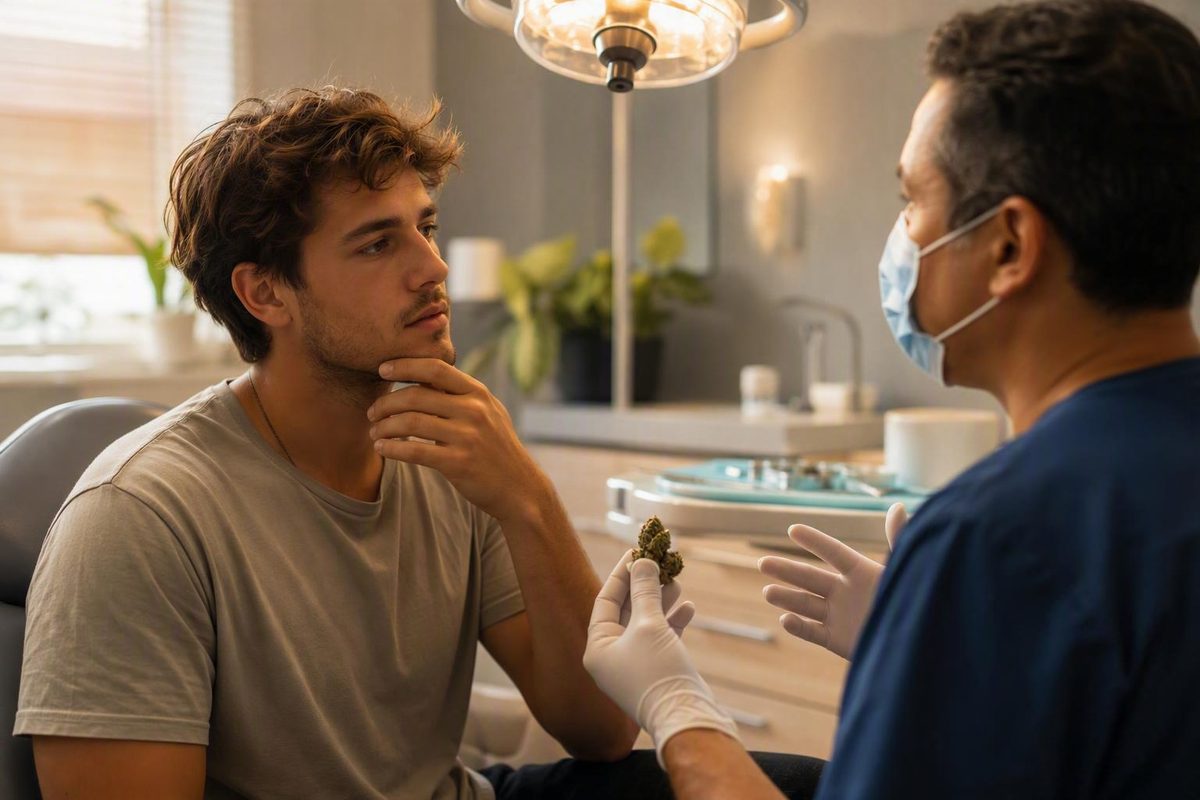
Yes—stop using cannabis before wisdom-teeth removal and follow the exact deadline from your surgeon or anesthesia provider. Regular use can affect IV anesthesia: a 2026 third-molar study found that heavy, long-term users received about 55% more propofol than the comparison group. Disclose your frequency, duration, route, amount, and last use even if you have already stopped. This applies to smoking, vaping, edibles, oils, tinctures, THC, and CBD.
Choose your use pattern and last-use window; the tool shows the closest study tier and creates a disclosure script.
This matches your answers to the closest description in the 49-patient third-molar study. It does not predict your dose or decide whether surgery can proceed.
This is a descriptive study match, not a recommended or expected propofol dose.
“I use cannabis weekly, monthly, or less and have used it for less than 1 year. My last use was 72+ hours ago. The product and route are: _____. The approximate amount is: _____.”
| Description In Summary | Reported Mean | How This Tool Matches It |
|---|---|---|
| Multiple daily, longer term | 262 mg | Multiple daily plus 3+ years, used as an approximation to the summary’s “more than two to three years” wording |
| Less frequent | 216 mg | Daily use, longer-term less-frequent use, or a pattern not clearly fitting the outer tiers |
| Less frequent and shorter term | 169 mg | Weekly, monthly, or less plus under three years |
The accessible summary does not give precise boundaries for every category or a separate nonuser mean. The tool therefore shows a closest description, not a clinical classification.
Stop further use and call before leaving home. Do not drive while impaired.
Call if this is inside your clinic’s cutoff. Published office policies include 48 hours, 72 hours, and seven days.
This is still inside the ACS 72-hour recommendation for marijuana products before general surgery.
Confirm your clinic’s rule. Some offices use longer restrictions, and stopping does not replace disclosure.
Source: May 2026 JOMS/AAOMS summary of 49 University of Washington third-molar patients; reported means 262 mg, 216 mg, and 169 mg of propofol. ACS provides the 72-hour general-surgery benchmark.
There is no evidence-based abstinence interval that fits every patient, cannabis product, procedure, and anesthesia plan. The American College of Surgeons recommends stopping marijuana products 72 hours before surgery, but its anesthesia warning is framed around general anesthesia. It is not proof that 72 hours is the universal rule for local anesthetic or every form of dental sedation (ACS patient guidance).
Your own office’s instructions take priority. If your appointment is within 72 hours and you were not given a cannabis cutoff, call now. Ask what anesthesia is planned, describe your usual use, and request a specific stop time. Continue following separate instructions about fasting, routine medicines, illness reporting, transportation, and a responsible adult.
Regular Use Can Increase Propofol Requirements
The most directly relevant research involved 49 adults older than 21 undergoing third-molar removal under intravenous general anesthesia at one University of Washington clinic. Published in May 2026, the study reported that people using cannabis multiple times daily for more than two to three years required about 55% more propofol than the comparison group.
The reported mean doses were:
| Cannabis-Use Description | Mean Propofol Dose |
|---|---|
| Multiple daily, longer term | 262 mg |
| Less frequent | 216 mg |
| Less frequent and shorter term | 169 mg |
The figures come from the AAOMS/JOMS study summary; the study is indexed in the PubMed record.
These numbers are not a dosing formula. The study was small and came from one clinic. The available summary does not provide a separate nonuser mean or enough detail to reconcile every category with the reported 55% comparison. It does not prove that cannabis caused the difference, that every user needs more propofol, or that stopping for a particular number of days returns anesthetic requirements to those of a nonuser.
It does show why “I use cannabis” is not enough information. Frequency and duration may remain relevant after a short pause. The anesthesia provider also needs the product, route, approximate amount, and exact time of last use so medication can be planned and adjusted while you are monitored.
Smoking and vaping create an additional concern because inhaled cannabis can irritate the throat and airway or contribute to coughing and wheezing. Vaping is not a safe preoperative substitute for smoking. Airway irritation is separate from the possible change in medication requirements.
Your Anesthesia Plan Changes the Timing Advice
Patients often use “sedation,” “anesthesia,” and “being put under” interchangeably. Ask the office whether the plan is local numbing medicine, an oral sedative, IV sedation, or general anesthesia.
| Anesthesia Plan | What Is Known | What To Do |
|---|---|---|
| Local anesthetic alone | No standard cannabis-abstinence interval has been established for numbing medicine alone. | Disclose use and ask for the clinic’s rule. Do not arrive intoxicated. |
| Oral sedation | No universal interval applies to every oral sedative or patient. | Confirm the medicine and cannabis stop time with its prescriber. |
| IV sedation | Private-practice policies range from 24 hours to seven days. | Follow your clinic’s written deadline rather than choosing the shortest policy. |
| General anesthesia | ACS recommends stopping marijuana products 72 hours before surgery. | Confirm with the anesthesia team and follow any longer deadline. |
Published office policies illustrate the variation. One clinician-reviewed practice advises most patients to stop at least 24 hours before oral surgery (Oral Facial & Implant Specialists guidance). An IV-anesthesia practice requires 48 hours without marijuana (Central Mass Oral Surgery instructions). Another requires at least three days without smoking marijuana (Alamat Oral Surgery Group instructions), while a stricter practice prohibits marijuana in any form for seven days before sedation (Premier Center instructions).
These are individual office policies, not a menu of medically equivalent choices. If your surgeon requires seven cannabis-free days, the general 72-hour benchmark does not shorten that requirement. The decision to proceed, alter the anesthesia plan, or postpone belongs to the surgeon or anesthesia provider.
For local anesthetic alone, the absence of a standard interval is not permission to use immediately before the appointment. It means the available evidence cannot establish one cutoff for everyone. Report recent use and ask the treating surgeon.
Smoking, Vaping, Edibles, THC, and CBD Still Require Disclosure
Smoking and vaping expose the airway to heat and irritants. Edibles, gummies, capsules, oils, and tinctures avoid smoke, but they are not automatically safe around sedation. THC may affect alertness or the response to sedating medicines, even when it is swallowed rather than inhaled.
CBD also needs to be disclosed. The available evidence does not establish one universal CBD cutoff for wisdom-teeth removal. Stop it if your surgeon, anesthesia provider, or prescriber instructs you to do so. Product labels may not always make the THC and CBD content clear.
Give the team these specific details:
- The product and whether it contains THC, CBD, or both
- Whether you smoke, vape, eat, swallow, or use it under the tongue
- The labeled concentration and approximate amount, if known
- Whether use is occasional, weekly, daily, or multiple times daily
- How many weeks, months, or years you have used it
- The exact date and approximate time of the last dose
- Current coughing, wheezing, shortness of breath, congestion, fever, or sore throat
- Alcohol, nicotine, other substances, medicines, and supplements
A useful disclosure can be one sentence: “I vape THC daily, last used yesterday evening, and have used it for three years.” Add the approximate amount and product strength if known.
If cannabis treats pain, sleep problems, anxiety, nausea, appetite loss, or another medical issue, explain that too. Tell the team before surgery if stopping is difficult or you think you may be dependent. That allows an individualized plan instead of an improvised substitute.
Disclosure does not guarantee that the procedure will proceed, but hiding use prevents the team from accounting for it safely.
Recent Use Requires a Call Before You Leave Home
If you used cannabis after the clinic’s deadline or on the day of surgery, stop further use and call the surgical office. State what you used, the amount, route, time, and your normal pattern. Report intoxication, unusual drowsiness, anxiety, dizziness, nausea, coughing, wheezing, or chest discomfort.
Do not conceal the use and hope no one notices. Feeling normal does not establish that sedation is safe. Do not drive to the appointment while impaired.
You also should not automatically cancel without calling. The decision can depend on the anesthesia plan, product, dose, timing, frequency, symptoms, health history, other medicines, and office policy. The team may proceed, change the plan, or postpone.
Continue following fasting and medication instructions unless the office changes them. Do not eat because you expect cancellation, and do not independently skip or take routine medicine. Keep transportation and responsible-adult arrangements in place until the office confirms otherwise.
Restarting Cannabis Is A Separate Healing Decision
Preoperative restrictions concern anesthesia and procedural safety. Postoperative restrictions also protect the blood clot that forms in the extraction socket. Losing or disturbing that clot can contribute to dry socket.
Wisdom Teeth Removal Recovery Has a Predictable Timeline advises avoiding smoking, straws, and spitting during the first 72 hours. That is a minimum early clot-protection period, not proof that smoking cannabis becomes safe for everyone at hour 72.
Published practice instructions vary. One clinician-reviewed source says smoking is commonly avoided for at least five to seven days after extraction and advises obtaining the surgeon’s clearance before restarting cannabis (AZ Max guidance). Other office policies extend general smoking and vaping restrictions to two weeks. These are practice policies rather than research-established cannabis restart intervals.
The practical rule is to avoid smoking and vaping during early healing and wait for your surgeon’s clearance. Suction, heat, coughing, and inhaled irritants can threaten the socket. Clearance may depend on extraction difficulty, continued bleeding or pain, whether the socket remains open, and how healing is progressing.
An edible is not an automatic workaround. Although it avoids smoke and suction, it may still be inappropriate while anesthesia is wearing off, while you are nauseated, or while taking a medicine that causes drowsiness. Ask before restarting THC or CBD in any form.
Pain that suddenly worsens around days two to four, radiates toward the ear, occurs with an empty or bone-white socket, or comes with a foul taste can indicate dry socket. Call the dental office the same day for worsening pain after day three. Fever over 101°F, pus, spreading swelling after day three, numbness lasting longer than a day, or uncontrolled bleeding also requires prompt contact rather than masking the symptoms with cannabis or extra pain medicine.
Common Timing Questions
Is 24 Hours Without Weed Enough?
Not necessarily. One private practice advises at least 24 hours for most patients, but other offices require 48 hours, three days, or seven days. Follow your own clinic’s deadline. If no instructions were provided and the appointment is within 72 hours, call the office rather than assuming 24 hours is sufficient.
Will Surgery Be Canceled If I Smoked The Night Before?
Not automatically, but only the treating team can decide. Stop further use and call before leaving home. Tell them the product, amount, route, time, usual frequency, and any symptoms. Do not hide the use or self-cancel without contacting the office.
Do Occasional And Daily Users Need The Same Precautions?
Both must follow the clinic’s stop instructions and disclose use. Frequency and duration may affect anesthesia planning, but the small third-molar study does not establish separate safe abstinence intervals for occasional and daily users. A brief pause also does not prove that a long-term daily user’s anesthetic needs become identical to a nonuser’s.
Can I Use Edibles Or CBD Instead?
Not without approval. They avoid smoke exposure but may still affect sedation, recovery, or other medicines. No universal CBD or edible cutoff has been established. Disclose the product before surgery and ask when it can be restarted afterward.
How Long Should I Wait To Smoke After Removal?
Avoid smoking and vaping throughout early clot formation, with 72 hours treated as a minimum rather than an automatic restart time. Some practices advise five to seven days or longer. Wait for your surgeon’s clearance, especially if the socket remains open or you still have bleeding, increasing pain, swelling, or other healing concerns.