
What Does a Dry Socket Look Like? Signs vs. Healing
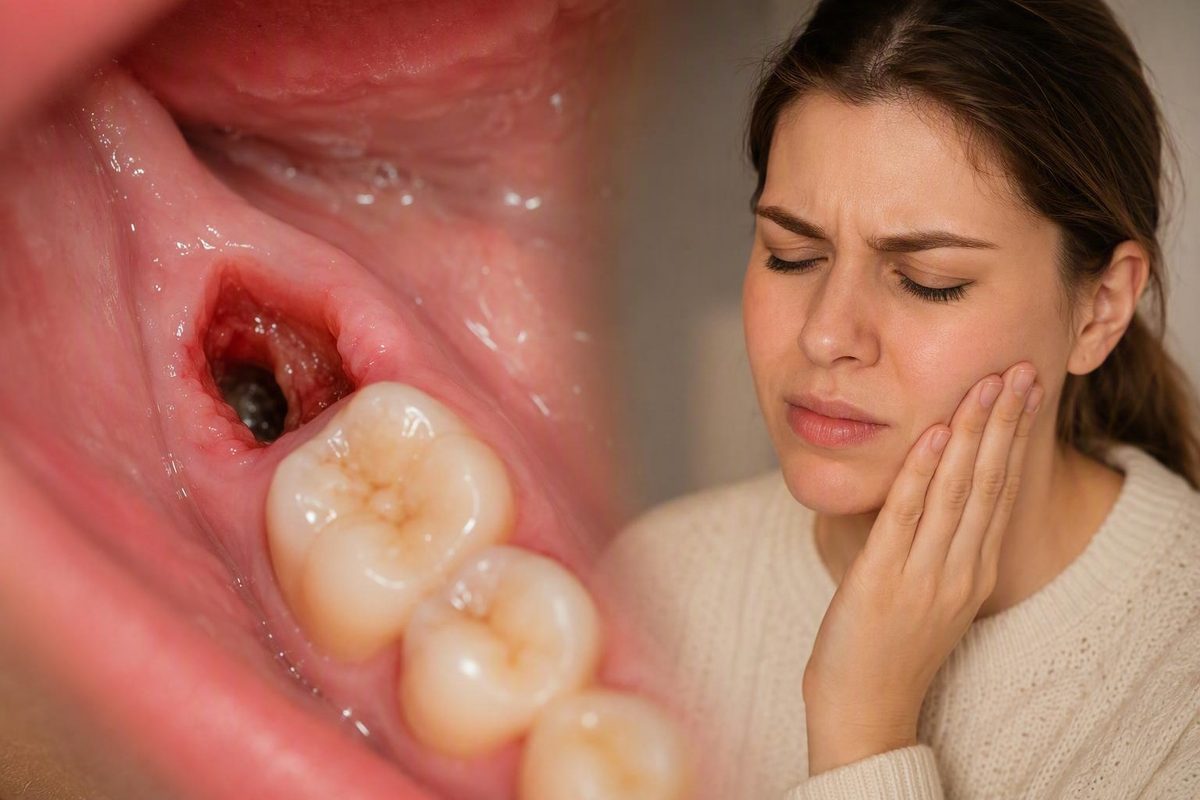
A possible dry socket may look unusually open or empty because the dark-red or maroon blood clot that normally protects the extraction site is missing or disrupted.
The short answer: what a possible dry socket can look like
A possible dry socket may look unusually open or empty because the dark-red or maroon blood clot that normally protects the extraction site is missing or disrupted. Pale white, grayish, or yellowish bone may be visible deep in the opening. The surrounding gum may look irritated, and food debris may collect in the socket. These are clues, not proof: Cleveland Clinic lists an absent clot, an empty-looking hole, and a whitish area of exposed bone as possible findings.
Appearance alone cannot diagnose dry socket. An open-looking hole or pale patch may raise concern, but lighting, socket shape, healing tissue, saliva, and trapped food can all affect what you see. The more informative warning pattern is severe pain that starts or becomes worse within several days of the extraction instead of steadily improving.
Possible signs include:
- Little or no visible dark clot
- A socket that looks unusually open or empty
- A pale area deep in the socket that may be exposed bone
- Irritated gum tissue around the opening
- Food or loose debris in the socket
- Severe, deep, throbbing, or raw pain
- Pain spreading toward the ear, jaw, temple, eye, or neck
- A persistent foul taste, odor, or bad breath
No single item confirms the condition. Redness, odor, debris, and pale tissue can all occur for reasons other than dry socket.
Wisdom-tooth sockets are particularly difficult to inspect because they sit far back in the mouth and may be partly covered by gum tissue, stitches, swelling, saliva, or food. Do not pull forcefully on your cheek, press on the surgical area, or insert anything into the opening to improve the view. If you cannot see the socket clearly, pay closer attention to whether your pain is improving or escalating.
If an image is used for comparison, a labeled clinical illustration is more useful than an unlabeled close-up. It should distinguish among:
- A normal dark clot
- Normal pale healing tissue
- Possible exposed bone
- Food or loose debris
These appearances may overlap in a mirror or image. Your pain history and an examination of the extraction site provide information that appearance alone cannot.
Dry socket versus normal healing at a glance
The most practical distinction is not whether the socket is dark, white, yellow, deep, or uneven on a particular day. It is whether pain and swelling are becoming more manageable or taking a clear turn for the worse.
During normal early healing, a dark-red or maroon clot may be visible before lighter repair tissue develops and the opening gradually narrows. With possible dry socket, the clot may be missing or disrupted, the opening may look more exposed, and pain may intensify or return after initially improving. This comparison is a guide rather than a self-diagnostic test; a dental-practice overview similarly emphasizes the combination of appearance and pain trend.
| Feature | More consistent with normal healing | More concerning for dry socket |
|---|---|---|
| Clot appearance | A dark-red or maroon clot may be visible early. It can become less obvious as new tissue develops. | The clot appears absent, partly lost, or disrupted, leaving a more open-looking socket. |
| White, cream, or yellow material | A stable pale layer may be fibrin or developing repair tissue. | A pale area deep in an exposed socket could be bone, especially when severe pain is present. |
| Pain trend | Soreness stabilizes and gradually becomes easier to manage. | Pain becomes severe, intensifies, or returns strongly after seeming to improve. |
| Timing | Discomfort and swelling may be prominent during the first few days before beginning to settle. | New or worsening pain commonly develops within several days of extraction. |
| Odor or taste | Blood residue, reduced cleaning near the site, or trapped food may cause an unusual taste or mild odor. | Persistent foul taste or odor can accompany dry socket, particularly with escalating pain, but does not prove it. |
| Gradual closure | The gum opening slowly narrows, although deeper healing takes longer. | The socket may remain open-looking, but its size or depth alone is not diagnostic. |
| Visible bone | Pale healing tissue can resemble bone. | Exposed bone may be visible, although tissue or debris can conceal it. |
| Response to pain medicine | The recommended pain plan generally makes ordinary soreness more manageable. | Severe pain may remain difficult to control, although medication response alone cannot establish the diagnosis. |
Two examples illustrate why the symptom trend matters:
- More consistent with healing: On the third or fourth day, you notice a stable white-yellow film. The opening still looks deep, but soreness is easing, swelling is not increasing, and daily activities are becoming more comfortable.
- More concerning: Pain started to settle and then became sharply worse. It feels deep or throbbing, spreads toward the ear, and the socket appears to have lost its dark clot.
Bad breath, an unpleasant taste, or trapped food can occur in either situation. Do not use socket color, size, or depth as a pass-or-fail test.
Why white or yellow material is not automatically exposed bone
White, cream, or yellow material is one of the most common reasons people become concerned about an extraction site. A pale socket, however, is not automatically dry socket, exposed bone, pus, or infection.
As healing progresses, fibrin and developing repair tissue can form a light-colored protective layer over or within the socket. That layer may look off-white or yellowish after the initial dark clot becomes less obvious. A white or yellow fibrin film is commonly described during normal wisdom-tooth healing and is not usually pus by itself (Midwest Oral Surgery).
The difficulty is that exposed bone can also look pale. Color alone cannot reliably distinguish among:
- Fibrin or granulation tissue: Repair material forming over or within the socket
- Exposed bone: Bone that may become uncovered when the protective clot is absent or breaks down too early
- Food debris: Material lodged in the opening that can change its appearance or odor
- Loose surface material: Debris or oral buildup obscuring the deeper socket
- Thick discharge: A more concerning finding when accompanied by fever, increasing swelling, spreading redness, or worsening pain
Food and loosely collected material can conceal exposed bone, so failure to see bone does not exclude dry socket. Conversely, pale tissue in poor lighting may be normal repair tissue rather than bone. A clinical review notes that exposed socket bone may be clearly visible or hidden beneath food and loosely collected material (PubMed Central).
Do not perform an at-home “tissue test.” Leave attached material alone and follow the cleaning and rinsing instructions supplied by your dental team.
A dentist or oral surgeon can inspect the site under appropriate lighting and, when indicated, gently remove loose debris to determine what lies underneath. If pain is steadily improving, an unusual pale appearance is generally less concerning than the same appearance accompanied by escalating pain.
What normal extraction healing may look and feel like over time
Healing varies with the tooth removed, the complexity of the procedure, the size and location of the socket, and the individual. Treat the following stages as a flexible guide rather than a diagnostic clock.
First one to two days
A dark-red or maroon clot may be visible in the opening. The socket can look deep, wet, dark, or irregular. Soreness, tenderness, swelling, and some early oozing may occur.
A large or uneven opening immediately after an extraction does not mean dry socket has developed.
Around days two to three
Soreness and swelling may be near their most noticeable before the overall trend begins moving toward improvement. The clot may remain dark, or its surface may start changing as repair tissue develops.
The important question is not whether the area is comfortable yet. It is whether symptoms are stabilizing and beginning to become more manageable rather than accelerating.
Roughly days three to seven
The site may appear lighter as white, cream, or yellowish tissue develops. The opening may begin to narrow while still looking visibly deep. A rough normal-healing sequence moves from an early dark clot to lighter tissue later in the first week, but the timing varies and should not be treated as exact (Broda Family Dental).
Over the following weeks
Gum tissue continues growing across the opening. Closure may be uneven, and the socket can briefly resemble a small dark hole as it contracts. Deeper healing continues after the surface has begun closing, so visible gum appearance does not reveal everything occurring underneath.
For more context about food, swelling, activity, and expected day-to-day changes, see the site’s wisdom-teeth recovery timeline. Your surgeon’s instructions remain the controlling guidance for your procedure.
At every stage, focus on direction:
- Decreasing pain and swelling, easier eating, and gradual closure support routine recovery.
- New, severe, or steadily worsening pain deserves professional assessment.
- A dramatic-looking socket that is becoming more comfortable is generally less concerning than an ordinary-looking socket with escalating, radiating pain.
Track how symptoms change between days rather than expecting one color or shape to prove that healing is normal.
The pain pattern that matters more than the picture
Some pain after an extraction is expected. It should generally become more manageable rather than developing into a new, deeper, or substantially more severe pattern.
Dry-socket pain commonly starts or worsens within several days of extraction. The supplied medical sources place the typical window broadly within the first through fifth postoperative days rather than on one guaranteed day. Mayo Clinic describes severe pain beginning within a few days—often one to three days after extraction—and recommends contacting the dentist or oral surgeon when pain is new or worsening (Mayo Clinic).
Concerning pain may be:
- Severe or out of proportion to the recent recovery trend
- Deep within the socket or jaw
- Throbbing, raw, aching, or sharply exposed
- Initially improved and then markedly worse
- Persistent rather than gradually settling
- Difficult to control with the pain medicine recommended by the treating clinician
Pain may spread from the socket toward the ear, jaw, temple, eye, or neck on the affected side. This radiating pattern can be more informative than whether you can see the bottom of the socket.
A foul taste, persistent odor, or bad breath may occur at the same time. These are associated clues, not confirmation. Blood residue, reduced cleaning around a tender surgical site, trapped food, infection, and other problems can produce similar symptoms.
Medication response is not diagnostic either. Routine postoperative pain varies among people and procedures. Nevertheless, severe pain that remains poorly controlled despite following the prescribed or recommended plan is a reason to contact the treating office.
Not seeing exposed bone does not rule out dry socket. The site may be too far back to inspect, or gum tissue, saliva, food, and other material may hide the socket’s base. Call your dentist or oral surgeon promptly if pain is new, severe, or worsening—especially if it radiates or returns strongly after initial improvement. Do not wait for the opening to change color before seeking advice.
Dry socket, infection, and other warning signs are not the same thing
Dry socket occurs when the protective clot fails to form properly, is lost prematurely, or breaks down before the extraction site has healed. The resulting exposure of underlying tissue can cause substantial pain. Dry socket is not ordinarily the same condition as a dental infection.
The distinction matters because some symptoms overlap. Bad breath or a foul taste may occur with dry socket, trapped food, bacterial buildup, or infection. Mild irritation around a recent extraction is also nonspecific.
Signs that may suggest infection or another complication include:
-
Fever
-
Pus or thick discharge
- Increasing facial swelling
- Swelling that worsens after initially improving
- Spreading redness
- Worsening pain accompanied by these symptoms
Call promptly for severe or worsening pain, fever, pus, or increasing swelling rather than assuming the problem is uncomplicated dry socket.
Antibiotics are not routine treatment for uncomplicated dry socket because the central problem is loss or breakdown of the protective clot, not necessarily infection. Antibiotics may be considered when a clinician suspects or confirms a separate infection. Do not start leftover antibiotics or assume that an empty or pale-looking socket requires them.
This distinction does not mean that every painful socket can be safely monitored. It means a dentist should determine whether the symptoms arise from dry socket, infection, retained debris, or another postoperative problem.
What to do if you think you have dry socket
Use a three-level decision path based primarily on symptoms rather than appearance.
1. Monitor while following your postoperative instructions
Monitoring may be reasonable when the socket looks unusual—dark, deep, white, yellow, or partly empty—but:
- Pain is steadily improving
- Swelling is stable or decreasing
- There is no fever or thick discharge
- Discomfort remains manageable with the plan provided by your dental team
- No new warning symptom has appeared
Continue following the individualized instructions from your dentist or oral surgeon. Those directions account for your extraction, medications, sutures, and procedure-specific circumstances.
2. Contact the dental office promptly
Call your dentist or oral surgeon if:
- Pain becomes severe
- Pain is newly worsening during the first several days
- Pain improved and then returned much more strongly
- Pain spreads toward the ear, jaw, temple, eye, or neck
- Recommended pain medicine provides inadequate relief
- The clot appears absent and pain is escalating
- You develop fever, pus, or increasing swelling
- You are unsure whether a change is safe to monitor
New or worsening pain in the days after extraction should be reported promptly even if the socket’s appearance has not changed (Mayo Clinic).
3. Seek urgent medical attention
Seek urgent medical care for:
- Difficulty breathing
- Difficulty swallowing
- Rapidly spreading swelling of the face or neck
- Any indication that swelling may be affecting the airway
These are not symptoms to monitor at home. Post-extraction guidance identifies spreading facial swelling and trouble breathing or swallowing as urgent warning signs (Midwest Oral Surgery).
While deciding what to do, do not:
- Poke or probe the opening
- Scrape away white or yellow material
- Pull at a clot or attached tissue
- Use suction to inspect or clean the socket
- Rinse forcefully
- Insert fingers, cotton swabs, tweezers, or other objects
- Use an irrigator unless your clinician has specifically instructed you to do so
- Put homemade remedies, oils, powders, dressings, or over-the-counter substances into the socket
A phone image may help show the office where you see a concern, but it does not convey whether pain is escalating, radiating, or responding to treatment. Lighting and angle can also change how pale tissue and shadows appear. Describe the symptom timeline when you contact the office rather than relying only on the image.
This article provides general information, not an individual diagnosis. Severe or worsening pain deserves assessment even when the socket cannot be seen clearly or looks unchanged.
How a dentist confirms and treats dry socket
A dentist or oral surgeon evaluates more than the socket’s color. Diagnosis combines your history—when pain began, whether it initially improved, whether it radiates, and how severe it is—with an examination of the extraction site.
The clinician may look for:
- Loss or breakdown of the clot
- An unusually exposed socket
- Visible bone
- Food or loose debris
- Irritated surrounding tissue
- Discharge or other signs suggesting infection
- Another local explanation for the pain
Imaging may sometimes be used to look for a retained tooth fragment or another cause of symptoms. Dental-practice guidance describes diagnosis as combining pain history and visual examination, with an X-ray sometimes used to exclude other complications (Robison Dental).
Professional care commonly includes gentle irrigation to remove loose debris, placement of a medicated dressing, and a pain-management plan. Follow-up may be needed depending on the dressing used and how symptoms change. Healthdirect similarly describes examination, professional cleaning, medicated dressings, and pain relief as elements of dry-socket care (Healthdirect).
The purpose of treatment is to reduce pain, keep the site manageable, and support healing. It does not guarantee immediate relief or an exact recovery date.
Antibiotics are generally considered only when infection is suspected or confirmed. A dentist can assess whether fever, discharge, swelling, or other findings justify infection treatment.
You do not need to uncover or clean the bottom of the socket before requesting help. Leave uncertain material in place and let the dentist or oral surgeon examine it.
Frequently asked questions
Does an empty-looking extraction hole always mean dry socket?
No. An empty-looking socket is a possible clue, but it does not establish dry socket by itself. Socket depth and shape vary, and the clot may be difficult to see because of the angle, tissue coverage, debris, or lighting.
An open-looking hole with mild discomfort that improves each day is less concerning than a similar-looking opening accompanied by sharply worsening, radiating pain. Contact the treating office when the appearance is paired with severe or escalating symptoms.
Can white or yellow material in the socket be normal?
Yes. White, cream, or yellowish material can be fibrin or developing repair tissue. A stable pale layer accompanied by steadily improving soreness is generally more consistent with routine healing than dry socket.
Exposed bone can also look pale, while thick discharge may appear yellowish. Color cannot identify the material on its own. Do not scrape or remove it; seek dental advice if it accompanies worsening pain, fever, increasing swelling, pus, or a persistent foul taste.
Can I have dry socket if I cannot see exposed bone?
Yes. Failure to see bone does not exclude dry socket. A wisdom-tooth socket may be too far back to inspect, and gum tissue, food, saliva, or loose material may conceal the deeper opening.
Pain history is often more useful than visibility. Severe pain that develops or worsens within several days—particularly pain that radiates or returns after initial improvement—warrants a call even when you cannot see the bottom of the socket.
When should worsening pain prompt a call to my dentist or oral surgeon?
Contact the treating office promptly when pain becomes severe, newly worsens, returns strongly after initial improvement, radiates toward the ear or jaw, or remains poorly controlled despite following the recommended pain plan. Do not wait until you can see bone.
Call promptly when worsening pain is accompanied by fever, pus, or increasing swelling. Follow the urgent-care threshold in the action section if swelling spreads rapidly or affects breathing or swallowing.
Do antibiotics treat dry socket?
Antibiotics are not routine treatment for uncomplicated dry socket. The underlying problem is usually failure, premature loss, or breakdown of the protective clot rather than infection.
Professional care generally focuses on clearing loose debris, applying a medicated dressing, and managing pain. Antibiotics may be prescribed when the dentist identifies or suspects a separate infection; do not use leftover antibiotics or assume they are needed because the socket looks pale or empty.
The key takeaway: An empty-looking opening or pale area can raise concern, but the clearest reason to call is pain that becomes severe or worsens instead of improving. Normal healing often includes white or yellow tissue, so do not touch, scrape, or probe the site. Ask a dentist or oral surgeon to assess worsening pain promptly. Seek urgent medical attention for rapidly spreading facial or neck swelling or any difficulty breathing or swallowing.