
IV Sedation vs General Anesthesia for Wisdom Teeth
Learn how moderate and deep IV sedation differ from full unconsciousness, including responsiveness, airway support, numbing and recovery needs.
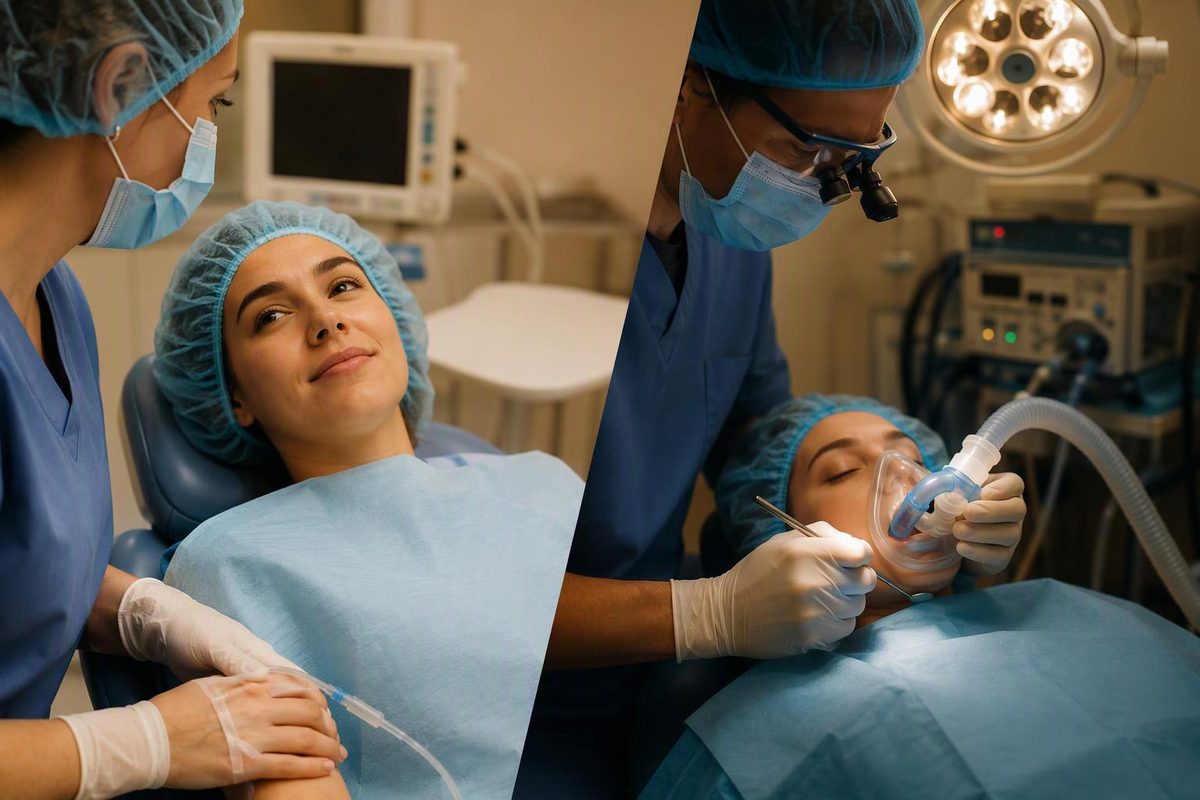
IV sedation and general anesthesia are not interchangeable terms: “IV” only means medicine enters through a vein, while the planned depth may be moderate sedation, deep sedation or general anesthesia. With moderate sedation, you are drowsy but can respond purposefully and usually breathe without help; with general anesthesia, you are fully unconscious and commonly need airway support. Deep sedation falls between them.
Ask the surgeon what depth of sedation is planned—not simply whether an IV will be used.
Choose a planned anesthesia level to compare awareness, breathing support, pain control and recovery.
Compare Planned Anesthesia Depth
Select the term your surgeon used. “IV” alone does not identify the depth.
Moderate IV Sedation
Show All Three Levels Together
| Level | Responsiveness | Breathing | Airway |
|---|---|---|---|
| Moderate IV | Purposeful response to voice or light touch | Normally adequate | Usually not required |
| Deep IV | Response after repeated or painful stimulation | May be inadequate | May be required |
| General | Not arousable, even with painful stimulation | Often impaired | Often required; positive-pressure ventilation may be needed |
Source: American Society of Anesthesiologists sedation continuum. Memory does not define sedation depth; individual responses can vary.
The Practical Differences
The American Society of Anesthesiologists’ sedation continuum defines the levels by responsiveness, airway support, spontaneous ventilation and cardiovascular function. Memory is not what determines the clinical category.
Moderate IV Sedation Preserves Purposeful Responses
With moderate IV sedation, you are very drowsy but can still respond purposefully to verbal commands, either alone or with light touch. Spontaneous breathing is normally adequate, and an airway intervention is not usually required.
Many patients remember little, but amnesia is not guaranteed. You should not choose moderate sedation on the assumption that you will certainly remember nothing.
Deep IV Sedation Can Require Airway Help
During deep sedation, you cannot be easily aroused. You may respond purposefully only after repeated or painful stimulation.
Your ability to breathe independently may become inadequate, and help keeping the airway open may be required. Little or no memory is common, but responsiveness—not recall—defines the level.
General Anesthesia Means You Are Not Arousable
Under general anesthesia, you are unconscious and not arousable, even with painful stimulation. Independent breathing is often impaired. Airway assistance and positive-pressure ventilation may be required.
An IV can be used to deliver general anesthesia, so describing a plan as “IV anesthesia” does not distinguish it from IV moderate or deep sedation. Ask about the intended consciousness level and expected airway management.
People do not always respond predictably to sedating medicines. A clinician providing sedation must be able to recognize and manage a patient who reaches a deeper-than-intended level.
IV Sedation Does Not Replace Local Numbing
Sedation reduces anxiety and awareness, but it does not by itself reliably numb a tooth. With IV sedation, the surgeon generally gives local anesthetic after you become relaxed. Mayo Clinic describes wisdom-tooth sedation anesthesia as IV medicine that makes the patient calm and sleepy, followed by medicine that numbs the gums (Mayo Clinic).
You may notice pressure, vibration or movement, but effective local anesthesia should prevent sharp extraction pain. See Does Wisdom Teeth Removal Hurt? for a stage-by-stage explanation.
Under general anesthesia, you are unconscious during the operation. The anesthesia team also provides pain control, and the surgeon may use local anesthetic as part of the plan. Ask what will be used rather than assuming that “being asleep” is the only pain-control measure.
The Best Option Depends on the Procedure and Patient
Neither IV sedation nor general anesthesia is automatically best for everyone. The choice can depend on:
- how many teeth are being removed and how difficult the surgery is expected to be;
- whether you can remain still and follow directions;
- anxiety and preference;
- age, medical history, airway assessment and current medicines;
- previous problems with sedation or anesthesia; and
- the clinician’s training, available monitoring and treatment setting.
The American Association of Oral and Maxillofacial Surgeons says IV moderate sedation can be used for procedures such as removal of impacted wisdom teeth. It describes patients as drifting between wakefulness and sleep, with few remembering much of the procedure (AAOMS).
General anesthesia may be considered when the operation is expected to be complex or complete unconsciousness is needed. Mayo Clinic says the expected difficulty of removal and the patient’s comfort level influence the anesthesia choice.
A deeper level increases the potential need for airway and breathing support, but these definitions alone do not establish one person’s risk. Medical assessment, monitoring and emergency readiness matter. The ADA’s comprehensively revised dental sedation and anesthesia guidelines were adopted in October 2025 and released in April 2026; the update emphasizes preoperative assessment, monitoring, oxygen delivery and emergency preparedness (American Dental Association).
Give the surgical team a complete medical and medication history, including previous anesthesia problems and use of prescription drugs, over-the-counter medicines, supplements, alcohol or cannabis. Do not stop a prescribed medicine unless the clinician responsible for your care tells you to.
Both Options Require Advance Preparation and a Ride Home
For either IV sedation or general anesthesia, follow the office’s fasting and medication instructions exactly. Requirements depend on the planned anesthesia. AAOMS advises patients having IV sedation or general anesthesia to follow their surgeon’s eating, drinking and medication directions strictly (AAOMS).
If you eat or drink outside those instructions, call the office before leaving home. Give the team accurate information so it can decide whether the procedure can safely proceed; do not conceal a deviation to avoid cancellation.
Arrange for a responsible adult to take you home. Do not plan to drive yourself, use machinery, work or handle dependent care immediately afterward. Keep surgery day clear because feeling awake does not prove that judgment and coordination have returned to normal. Recovery from anesthesia is also separate from healing of the extraction sites.
Confirm how long supervision is required. One NHS dental service instructs its IV-sedation patients to have adult supervision and avoid driving, machinery, alcohol, work, dependent care and irreversible decisions for 24 hours (Rotherham NHS Foundation Trust). General-anesthesia discharge guidance from another NHS service requires an escort, 24-hour supervision and no driving for 24 hours (Cambridge University Hospitals). These are instructions from specific services, not a universal rule; your own team’s directions take priority and may be stricter.
Ask the Surgeon to Define the Planned Depth
Before consenting, ask:
- When you say “IV sedation,” do you mean moderate sedation, deep sedation or general anesthesia?
- Will I be expected to respond during the procedure?
- What airway or breathing support might be used?
- Who will give the sedation or anesthesia, and who will monitor me while the surgeon operates?
- Why does this level fit my procedure and health history?
- Is local anesthesia alone a reasonable alternative?
- What are my exact fasting and medication instructions?
- How long must my escort stay, and when may I drive, work or be alone?
- What will each option cost, and what does my insurance cover?
If the consent form says only “IV anesthesia” or “twilight,” ask for clarification. The useful answer identifies the planned level of consciousness, expected monitoring and airway plan—and why that plan fits your procedure and medical history.