
Benefits of a Bone Graft After Wisdom Tooth Removal
A graft may preserve support behind the second molar when removal leaves a substantial defect, but routine wisdom-tooth sockets usually do not need one.
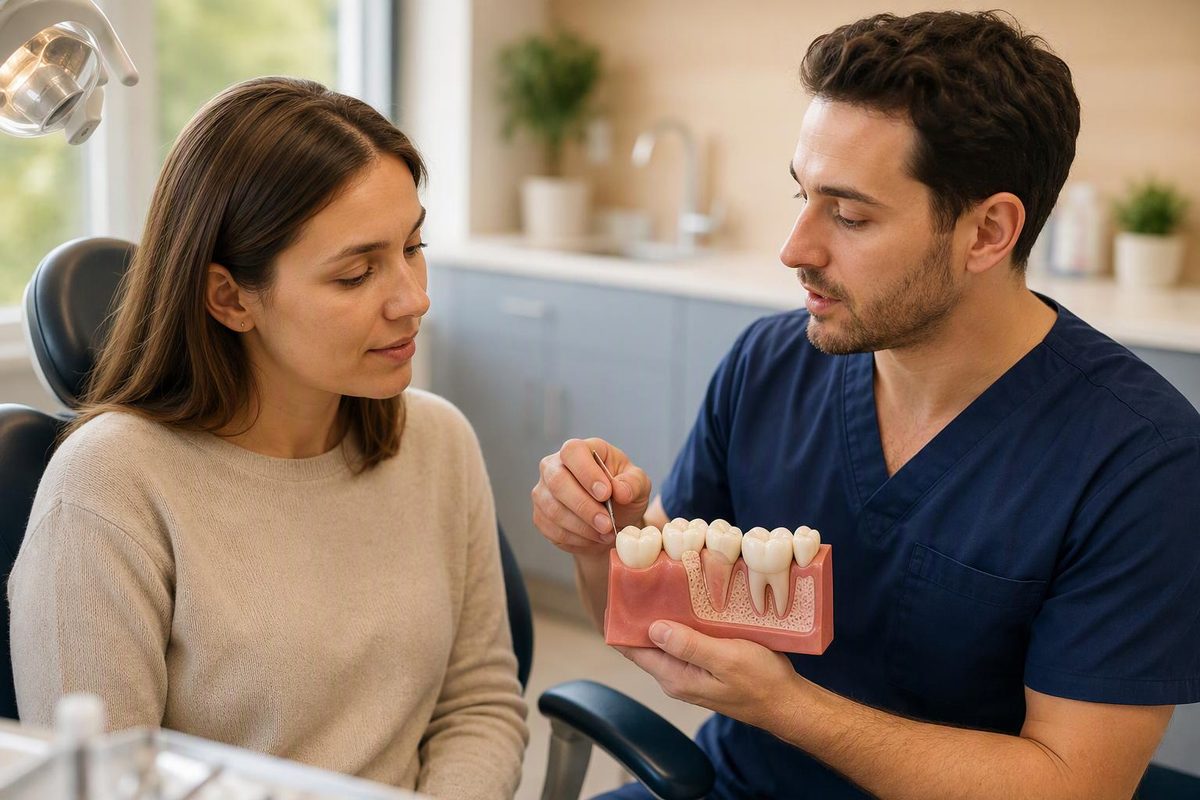
The main potential benefit of a bone graft after wisdom tooth removal is preserving bone and gum support behind the neighboring second molar. This can matter when an impacted lower wisdom tooth—or the surgery needed to remove it—leaves a substantial defect in that area.
A graft is not routinely needed in every wisdom-tooth socket. The American Association of Oral and Maxillofacial Surgeons (AAOMS) says grafting may be considered for a significant bone or soft-tissue defect, while routine grafting is not indicated for all patients (AAOMS clinical paper).
What the graft is intended to do
A surgeon places graft material in the extraction site, sometimes with a membrane. The material holds space and acts as a scaffold while the body forms bone; it does not become a solid piece of jawbone immediately. Cleveland Clinic’s bone-graft overview says initial recovery may take about a week, but the graft itself needs at least three months to heal and larger grafts can take longer.
In a selected lower-wisdom-tooth case, the practical aims may be to:
- increase bone fill in a defect behind the second molar;
- reduce the depth of a persistent gum pocket at the back of that tooth;
- improve the second molar’s attachment and bony support; or
- rebuild an area where disease or surgery has left a substantial defect.
A 2025 overview of 33 systematic reviews found that ridge-preservation procedures improved probing depth, clinical attachment and bone height behind lower second molars. The authors also cautioned that the studies had substantial heterogeneity and variable quality, so the average results do not mean every patient benefits from grafting (review in Oral and Maxillofacial Surgery).
Who is more likely to benefit?
The decision is usually driven by the condition of the second molar and surrounding bone, not simply by the presence of an empty wisdom-tooth socket.
AAOMS identifies several features associated with a greater risk of a lasting defect:
- a significant bone or attachment defect before extraction;
- a deep periodontal pocket behind the second molar;
- a horizontal or forward-leaning lower wisdom tooth;
- a large contact area between the wisdom tooth and second molar;
- root resorption of the second molar;
- a pathologic follicle around the wisdom tooth; and
- older age at removal.
The AAOMS paper says patients age 26 or older with deep horizontal impactions are among those who may benefit from an added intervention. It also notes that younger patients tend to have fewer and less severe defects, which may improve over time. Age is one factor, not an automatic cutoff.
For a broader explanation of when this treatment may be reasonable, see when a bone graft after wisdom teeth is—and is not—usually needed.
What the evidence does—and does not—show
A systematic review of three small randomized trials included 81 healthy nonsmokers. It found better gum-pocket depth and attachment outcomes when lower wisdom-tooth sockets received an animal-derived graft plus a collagen membrane rather than healing without that intervention. Only one trial had a low risk of bias, and the reviewers called for larger studies (systematic review).
That evidence concerns periodontal healing behind the lower second molar. It does not establish that grafting every wisdom-tooth socket:
- prevents dry socket;
- produces faster pain relief or gum closure;
- benefits every upper-wisdom-tooth extraction; or
- replaces clot protection and normal aftercare.
This is also different from preserving a socket for a future dental implant. Wisdom teeth generally are not replaced. In this setting, the relevant reason for grafting is usually to protect neighboring structures or repair a substantial defect—not to prepare for a wisdom-tooth implant.
Questions to ask before agreeing
If a graft is recommended, ask the surgeon to show you the defect on the examination or image and explain:
- What problem is the graft treating? Is there existing bone loss, second-molar root exposure or an expected loss of supporting bone during surgery?
- What is likely without it? A small defect may be expected to improve without grafting, while a substantial defect may have a greater chance of persisting.
- What material will be used? AAOMS lists options including the patient’s own bone, processed donor bone, synthetic ceramic material and resorbable or nonresorbable membranes.
- How will healing be checked? Ask whether the site needs a later gum-pocket measurement or radiograph.
- What does it add? Request the separate cost and ask how the graft changes the procedure, aftercare and risks in your case.
A recommendation should be tied to a specific existing or expected defect and a clear intended benefit—not merely to the fact that a wisdom tooth is being removed.
After surgery, follow the surgeon’s graft-specific instructions. A few sand-like particles may escape during early healing; Cleveland Clinic advises contacting the provider if a large amount is lost. Contact the surgical office promptly for fever, pus, increasing pain or swelling, excessive bleeding, or another symptom that concerns you (AAOMS complication guidance).